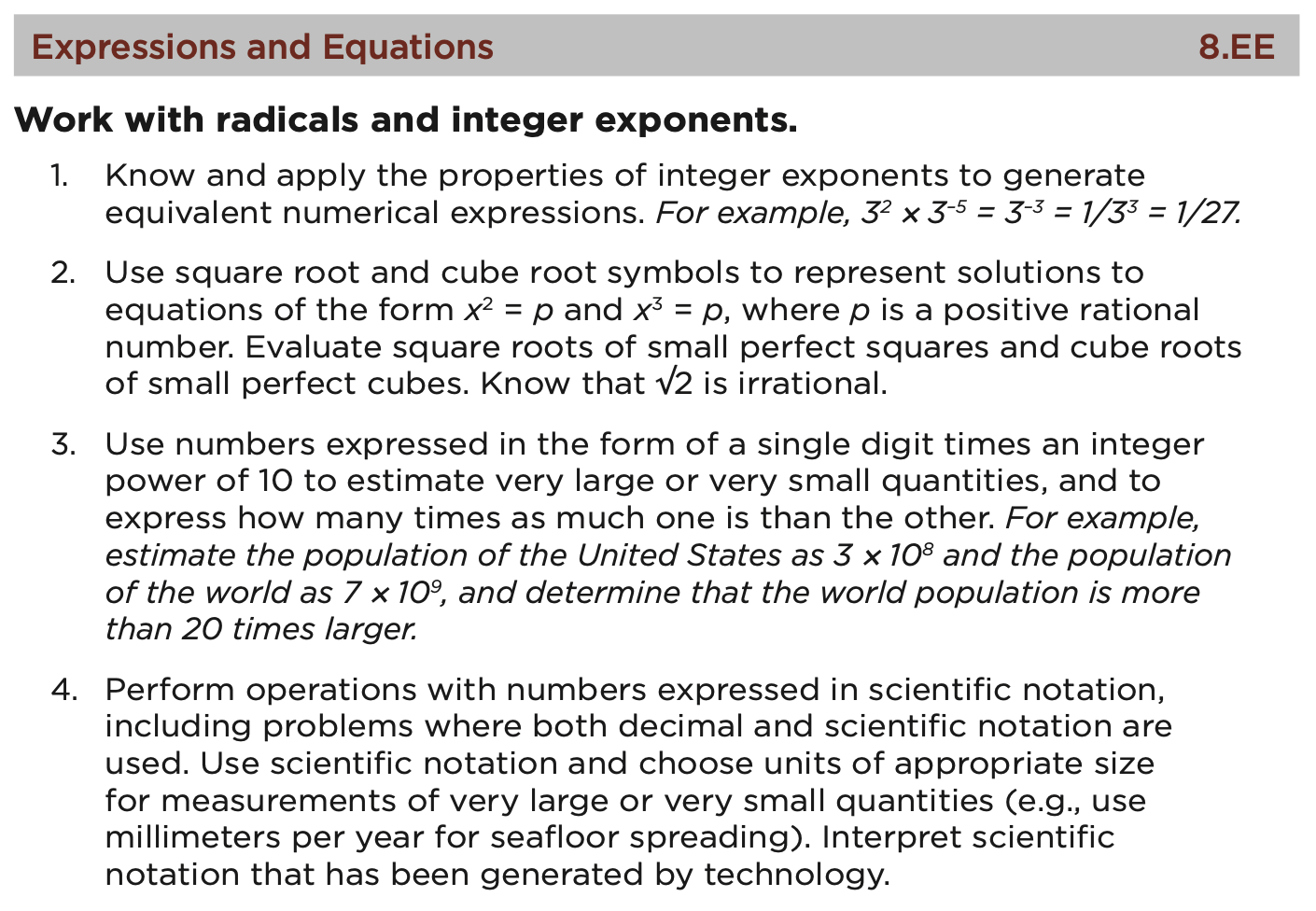
Figure2.1.1.Scientific Notation from CCSS for 8th Grade
Activity2.1.1.Abby’s Lesson on Scientific Notation.
Abby is teaching scientific notation as part of her 8th grade curriculum. You can see the details from the Common Core State Standards 8.EE #4 as given in Figure 2.1.1. She begins by discussing the process for converting back and forth between numbers written in standard Hindu-Arabic form and those written in scientific notation.
Abby : Today we are going to look at another way to write numbers when they become so long that we really don’t need to use all of their digits. When a number gets so big, the digits closest to the units really don’t matter so much. Suppose you are Elon Musk and you decide to buy a new jet. The jet costs $200,000,000. Further suppose Mr. Musk is currently worth roughly $412 billion. After the purchase of the jet, how much is Elon Musk worth? Yes, Kate.
Kate : $411.8 billion?
Abby : Good, but let’s just keep it in whole billions.
Kate : OK, $412 billion?
Abby : Nice! So did his purchase really matter much when it come to his wealth? Toby?
Toby : Not at all. That’s like me worrying about fifty cents.
Abby : So what we are going to talk about today is called scientific notation and it’s used when numbers are so big that we don’t really need to worry about all the digits. Suppose we are looking at the number 372400. Instead of writing all of the digits, we can instead write it as a power of 10. If move the decimal point to the left until it is between the 3 and the 7 and count how many places we move it [Abby writes the number placing the decimal point at the far right and then draws curved half circles under the digits to indicate movement of the decimal point from place to place, counting as she goes], we can use the number of places we move it as the power of 10. This means that \(372400=3.724 \times 10^5\text{.}\) So you just need to count the moves.
Mia : Why are the moves the same as the power of 10?
Abby : That’s just how we write the new notation to shorten it. Let’s try another example for a really big number. That might help. How would you write 5,681,000,000,000 in scientific notation? Yeah, Ja’miya.
Ja’miya : Well, I guess we’d just count to get it between the 5 and 6, so let’s see, one, two, three, four, five, six, seven, eight, nine, ten, eleven, twelve. So twelve. So would it be \(5.681 \times 10^{12}\text{?}\)
Abby : Great. Does that help, Mia?
Mia : Not really. I’m still not sure why the power of ten is the same as counting the moves.
Abby : Well, let’s just practice a few more and see if that helps.
Mia rolls her eyes and starts talking to her group mates.
(a)
Individually, describe what you think are the central issues involved in the classroom exchange.
(b)
In your groups, share your thoughts about the classroom dialogue and come up with a list of things you think went well and not-so-well.
(c)
In light of our class discussions, how would you handle the same situation in your classroom? Give specific examples to illustrate what you would do.
(d)
In the vignette, Mia seemed to be frustrated that her question was being ignored. What do you think are the main mathematical concepts involved in the classroom discussion? How are place value and scientific notation connected?
(e)
Discuss how the connection between place value notation and scientific notation are related to Pirie and Kieren’s construct of “folding back”.
As you may have noticed in the vignette, Mia became frustrated because her question about why the process Abby was describing worked was being ignored. In order to teach mathematics, we much have a deeper understanding of mathematical concepts so that we do not resort to procedural approaches to teaching out of our own lack of understanding. To this end, let’s dive a little deeper into numeration and number systems and explore why we write numerals as we do.
Throughout mathematics, humankind has found the need to expand its numeration systems. While some cultures developed symbol systems to represent the concept of number, others relied (and still rely on) linguistic representations. For example, some studies suggest that the Pirahã tribe in Brazil have a limited system consisting of just "one", "two", and "many". Scholars are still debating this tribe’s concept of number, but one might ask, why only three words for numbers? As we examine the concept of number, it is important to realize that number is usually tied to a culture. Imagine a culture where people possess very few things. If there is no need to keep track of possessions, why invent a number representation to express them? If very few people have more than two of anything and there is no need to compare quantities, why bother? "Many" should suffice. Throughout history, we will see that the expansion of a number system is usually triggered by a necessity for describing amounts or quantities.
Another distinction we need to make is the difference between a number and a numeral. In society, these words are often used interchangeably, but they have quite different meanings. A number is a concept or property. For example, the fingers on my hand have a property of "fiveness". If I count them, I can place them in a one-to-one correspondence with the words {one, two, three, four, five}. Both of these sets share a property of "fiveness". Any other set that can be placed into a one-to-one correspondence with these sets (fingers or words) can be said to have the property of "fiveness" and thus we say that there are "five" things in the set. Here five is a number concept. In contrast, "5" is a symbol that we use to represent the concept of five. I guess, the word "five" is also a symbol (or collection of symbols) that we use to represent the concept of five. This is the distinction between number and numeral. A number is a concept while a numeral is a symbol that is used to denote the concept. This will become a more important distinction later when we look at how we develop symbolic meaning in an algebraic sense.
Subsection2.1.1Elementary Whole Number Systems
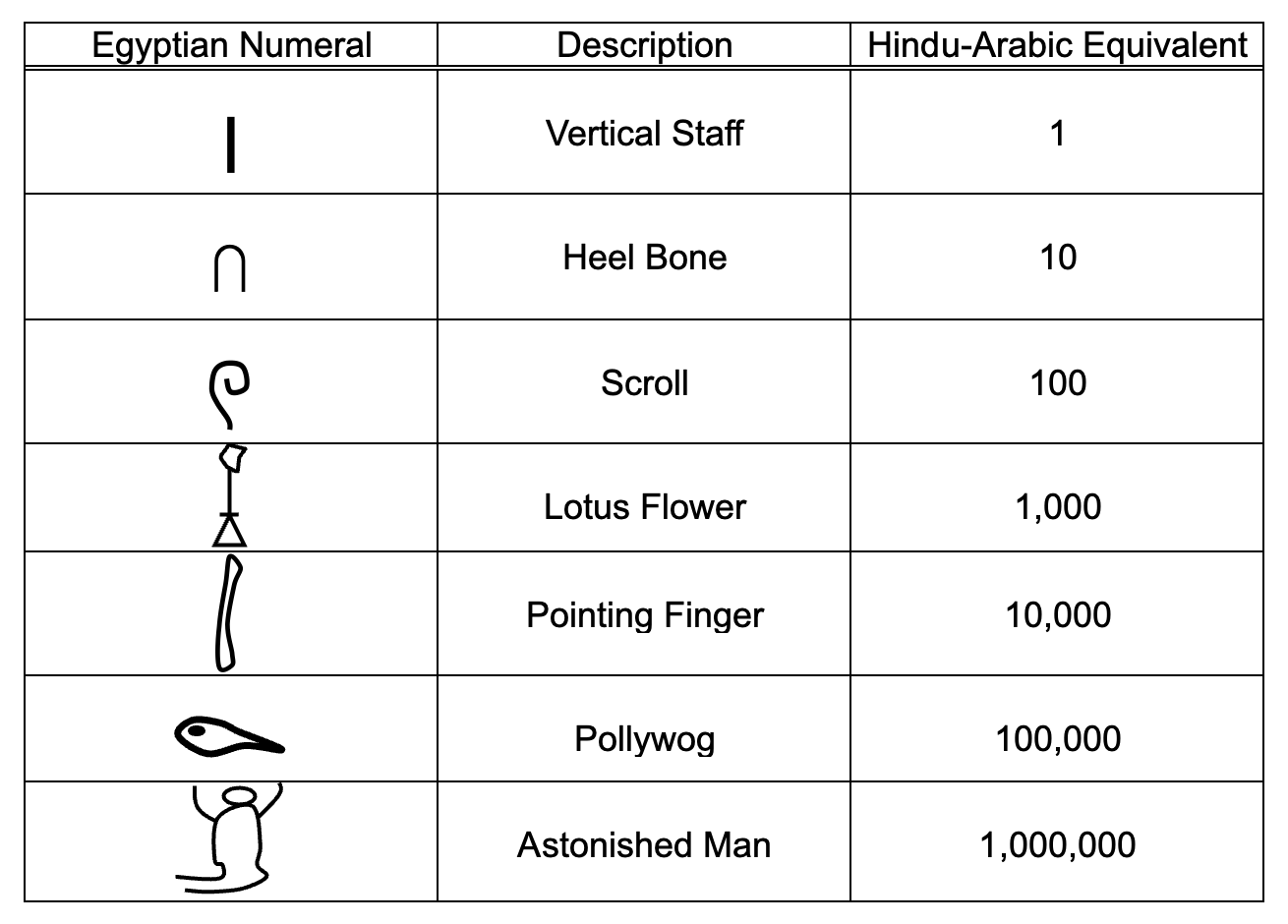
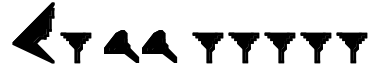
One of the earliest numeration systems was the tally system or what we like to call the WYSIWYG (what-you-see-is-what-you-get) system. In this system, simple tally marks represented a number. For example, suppose you had seven bags of grain. In the tally system, the person would represent their possessions as |||||||. As you can imagine, this would be fine if you had little, but if you had many possessions, it would quickly become cumbersome. The Egyptians developed a way of eliminating the need for tally marks by inventing new symbols to represent groups of objects. In this case, the Egyptians grouped by ten (probably due to the fact that people had ten fingers and when counting on fingers, to keep track, they would need to begin again on the first hand after counting to ten). Once they collected ten of something, they created a new symbol to represent a bundle of ten. Once ten of those bundles were gathered, they created another symbol to represent ten bundles of ten and so on (see Figure 2.1.2). This way, to write a numeral, they would never need to have any more than nine of any symbol. They used the following symbols to represent various powers of ten.
Figure2.1.2.Egyptian Numeral System
With each different symbol, the Egyptians could now write larger numbers using a more condensed collection of symbols than in a tally system. For example, suppose we wish to express the number 31,254. In our Hindu-Arabic system, we allow each space to represent a different power of the base (ten in this case). Thus, \(31,254=3\cdot 10^4+1\cdot 10^3+2\cdot 10^2+5\cdot 10^1 +4\) expressed in expanded base-ten notation. The Egyptians, on the other hand, did not use the spatial location of the symbols to convey the specific power of the base, but rather they created a different symbol for each power (size bundle). Therefore, the number 31,254 would be written as
Figure2.1.3.Egyptian Numeral for 31,254
Although this system was a great improvement over the tally system of numeration, it doesn’t take long to see a major drawback. Since each new power of the base requires a new symbol, expressing larger and larger numbers becomes cumbersome. In order to express any given positive integer, the Egyptian system requires an infinite number of symbols.
Activity2.1.2.
Consider the following numerals written in our standard Hindu-Arabic system.
(a)
Write 7,521 in the Egyptian system.
(b)
Write 582,346 in the Egyptian system.
(c)
Write 2,141,425 in the Egyptian system.
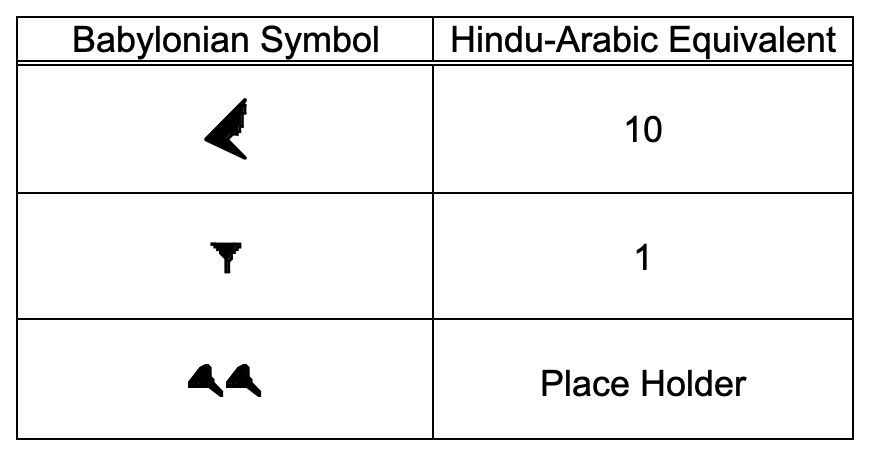
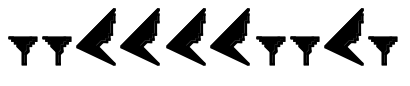
So how do we improve on the problem of needing to create new symbols for each power of ten (or any base for that matter)? The ancient Babylonians developed a place-value system for representing any positive integer using a finite number of symbols. The Babylonians used the position of the symbol or collection of symbols to represent the power of the base (in this case a base sixty system which meant that in any single position, the symbols could total at most fifty-nine). Although they bundled in groups of sixty, they had only two symbols along with a place holder to be used for when there were no bundles of a certain power of the base (see Figure 2.1.4). The early Babylonians did not use the place holder, but the confusion caused by not being able to indicated easily when there were no bundles of a certain size necessitated the creation of a symbol to "hold an open space". The Babylonians did not have a fully functioning zero, but the place holder provided a way to indicate no bundles of a specific size by its location in the string of symbols.
Figure2.1.4.Babylonian Numeration Symbols
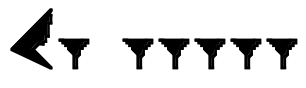
To illustrate, consider the expanded base sixty notation as written using our familiar Hindu-Arabic numerals. Here we have \(39,605=11\cdot 60^2+0\cdot 60 +5\text{.}\) And so the early Babylonians would write this number as
The problem was in how this numeral could be interpreted. Did this collection of symbols mean \(11\cdot 60+5=655\) or \(11\cdot 60^2+0\cdot 60+5=39,605\text{?}\)
To make this expression less ambiguous, the placeholder was used to express the meaning more clearly. Thus the later Babylonian system would write the intended number as
As we shared before, although the use of the placeholder serves the same role as our zero in the Hindu-Arabic system, the Babylonians did not recognize the concept of zero as being a number representing nothing.
Activity2.1.3.
Consider the following numerals written in our standard Hindu-Arabic system.
(a)
Write 1,422 in the Babylonian system.
Hint.
How many bundles are there of size \(60\text{,}\)\(60^2\text{,}\)\(60^3\text{,}\) etc.?
(b)
Write 1,123,426 in the Babylonian system.
Hint.
How many bundles are there of size \(60\text{,}\)\(60^2\text{,}\)\(60^3\text{,}\) etc.?
(c)
Write 147,637 in the Babylonian system.
Hint.
How many bundles are there of size \(60\text{,}\)\(60^2\text{,}\)\(60^3\text{,}\) etc.?
(d)
Write the following Babylonian numerals as Hindu-Arabic base-ten numerals.
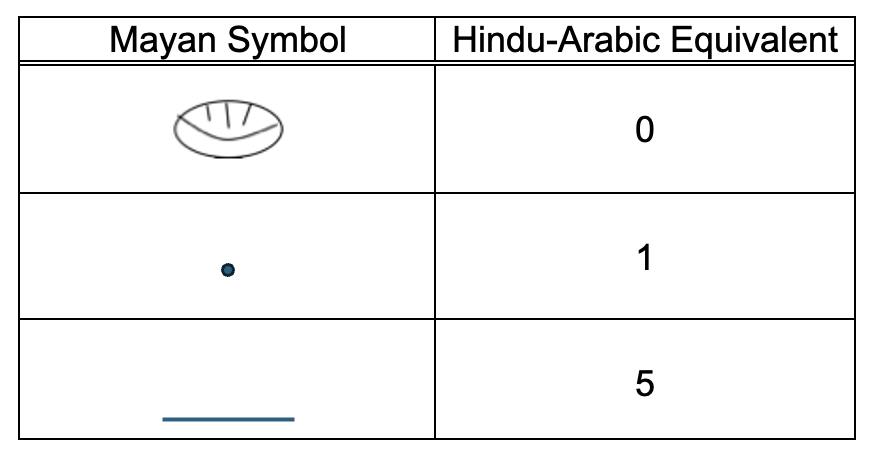
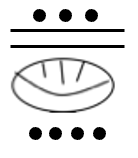
The ancient Mayan civilization were probably the first to fully recognize the concept of zero. The Mayans also used a place-value numeration system. In this case, their grouping number was twenty. They actually had a pseudo base twenty system since their place values progressed as: \(1, 20, 18\cdot 20, 18\cdot 20^2, 18\cdot 20^3, \ldots\text{.}\) The reason for the deviation from \(20^2\) was due to their calendar that had 18 months with 20 days per month (\(18\cdot 20=360\)). Like the Babylonians, the Mayans had very few symbols. The difference is that the Mayans had a symbol for zero (or nothing) represented by an empty oyster shell. This was different from the Babylonians in that the Mayan’s symbol was not just a placeholder, but rather was a symbol representing nothingness. The symbols are given below.
Figure2.1.5.Mayan Numeration Symbols
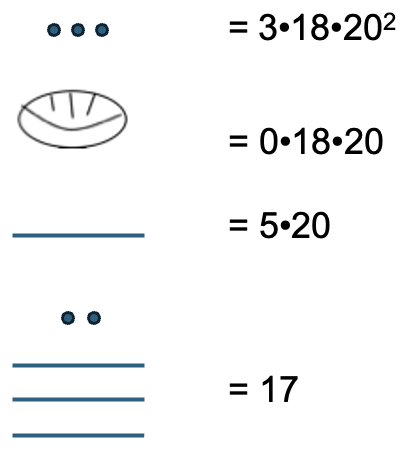
Like the Babylonians, the position of the collection of symbols determined the power of the base. However, unlike the Babylonians, the Mayan base is not exactly uniform. Instead of a base twenty system, they used a pseudo-base twenty system. The reason for this is that the base was tied to their calendar year. The Mayan calendar contained 18 months each containing 20 days. The result was a 360-day year. This can be seen below by the replacement of the normal place value, \(20^2\text{,}\) with the place value of \(18\cdot 20\text{.}\) After this, the place values simply increase the power of 20 by one for each successive place. The Mayans wrote the numerals vertically with the higher powers of the base above the lower powers and the symbol for zero was used as a placeholder. Within a single place value location, the unit dots would be written above the horizontal bars that each represented five. For example, the number \(21,717=3\cdot 18\cdot 20^2+0\cdot 18\cdot 20+5\cdot 20+17\text{,}\) in Hindu-Arabic would be written as
To this point, civilizations had focused mainly on representing the natural or counting numbers, \(\mathbb{N}=\left\{1,2,3,4,\ldots\right\}\text{.}\) The Mayans extended this system to include zero \(\left\{0,1,2,3,4,\ldots\right\}\text{,}\) often referred to as the whole numbers. Some texts include 0 in the set of natural numbers and refer to the counting numbers as the positive integers, denoted \(\mathbb{Z}^+\text{.}\) Thus, the use of \(\mathbb{Z}^+\) seems to be less ambiguous since zero is neither positive nor negative and so we will use \(\mathbb{Z}^+=\left\{1,2,3,4,\ldots\right\}\text{.}\)
With the advancement of a place-value system, cultures evolved to use different symbols for each face value (i.e. the symbols used to represent the number of any particular sized bundle). These symbols were dependent on the base (or bundle size) that was used. For example, in our current commonly used base system, (base ten), we have ten symbols since once we get ten of anything, we bundle them and we create another bundle of the next place value space. For base six, there would be six symbols. For base, there would be three symbols, and so on. Therefore, in base ten, we have the symbols 0, 1, 2, 3, 4, 5, 6, 7, 8, and 9. The symbols used here are the Hindu-Arabic numerals (not to be confused with Arabic numerals) used on many Middle Eastern countries (see Figure 2.1.6). Both use a base-ten place-value system.
Figure2.1.6.Arabic vs Hindu-Arabic Numerals
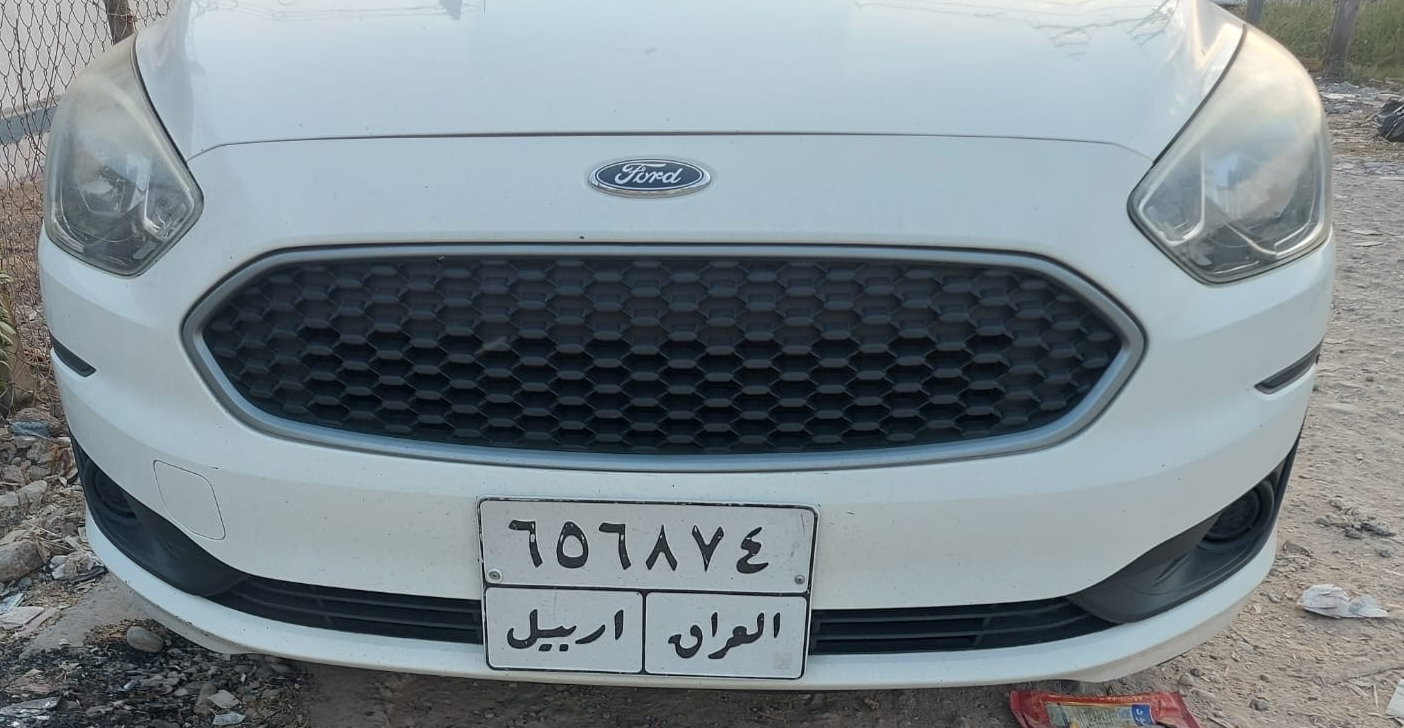
An interesting fact is that even though Arabic is written right-to-left, the numerals are still written left-to-right. This is due to the fact that the symbols were adopted from India where language is written left-to-right. This means that while reading text, you would read right-to-left until reaching a numeral and then switch to left-to-right for the number and then switch back to right-to-left as you continue to read the text. Again, this shows how mathematics and language are both culturally connected. Below (Figure 2.1.7) is a picture of a license plate from Iraq from 2025. This would be read as 656874 in our Hindu-Arabic symbols. Iraq was in the process to switching to the use of the Western Hindu-Arabic numerals at the time and this is an older plate that had not yet been replaced.
In this activity, we will explore how different bundling sizes impact the way numerals are used to represent a whole number. In Figure 2.1.12 and Figure 2.1.13 you see videos that show how place value is used to express the number "twenty-three". Notice that we use the English term "twenty-three" here since the number "twenty-three" will look different as a collection of numerals or digits depending on how we decide to bundle.
(a)
Begin by counting out forty-three bundling sticks. Form as many bundles of ten as you can and record the number of bundles of size ten along with any remaining sticks left unbundled using the digits 0, 1, 2, 3, 4, 5, 6, 7, 8, or 9.
Table2.1.8.Bundling By Ten
Bundles of Ten
Leftover Units
We can use expanded base-ten notation to write 43 as:
Write a base ten numeral for this amount: _________________________
(b)
Starting over with the same forty-three bundling sticks. Form as many bundles of eight as you can and record the number of bundles of size eight along with any remaining sticks left unbundled using the digits 0, 1, 2, 3, 4, 5, 6, or 7.
Table2.1.9.Bundling By Eight
Bundles of Eight
Leftover Units
Write a base eight numeral for this amount: _________________________
(c)
Starting over with the same forty-three bundling sticks. Form as many bundles of six as you can and record the number of bundles of size six along with any remaining sticks left unbundled using the digits 0, 1, 2, 3, 4, or 5. If you get six bundles of six, form a "super bundle".
Table2.1.10.Bundling By Six
Six Bundles of Six
Bundles of Six
Leftover Units
Write a base six numeral for this amount: _________________________
(d)
Starting over with the same forty-three bundling sticks. Form as many bundles of five as you can and record the number of bundles of size five along with any remaining sticks left unbundled using the digits 0, 1, 2, 3, or 4. If you get five bundles of five, form a "super bundle".
Table2.1.11.Bundling By Five
Five Bundles of Five
Bundles of Five
Leftover Units
Write a base five numeral for this amount: _________________________
(e)
Based on your responses from the earlier part of this activity, we can say that the same forty-three sticks can be expressed as:
Figure2.1.12.Using Bundling Sticks to Represent Twenty-Three
Figure2.1.13.Using Base Blocks to Represent Twenty-Three
Activity2.1.5.
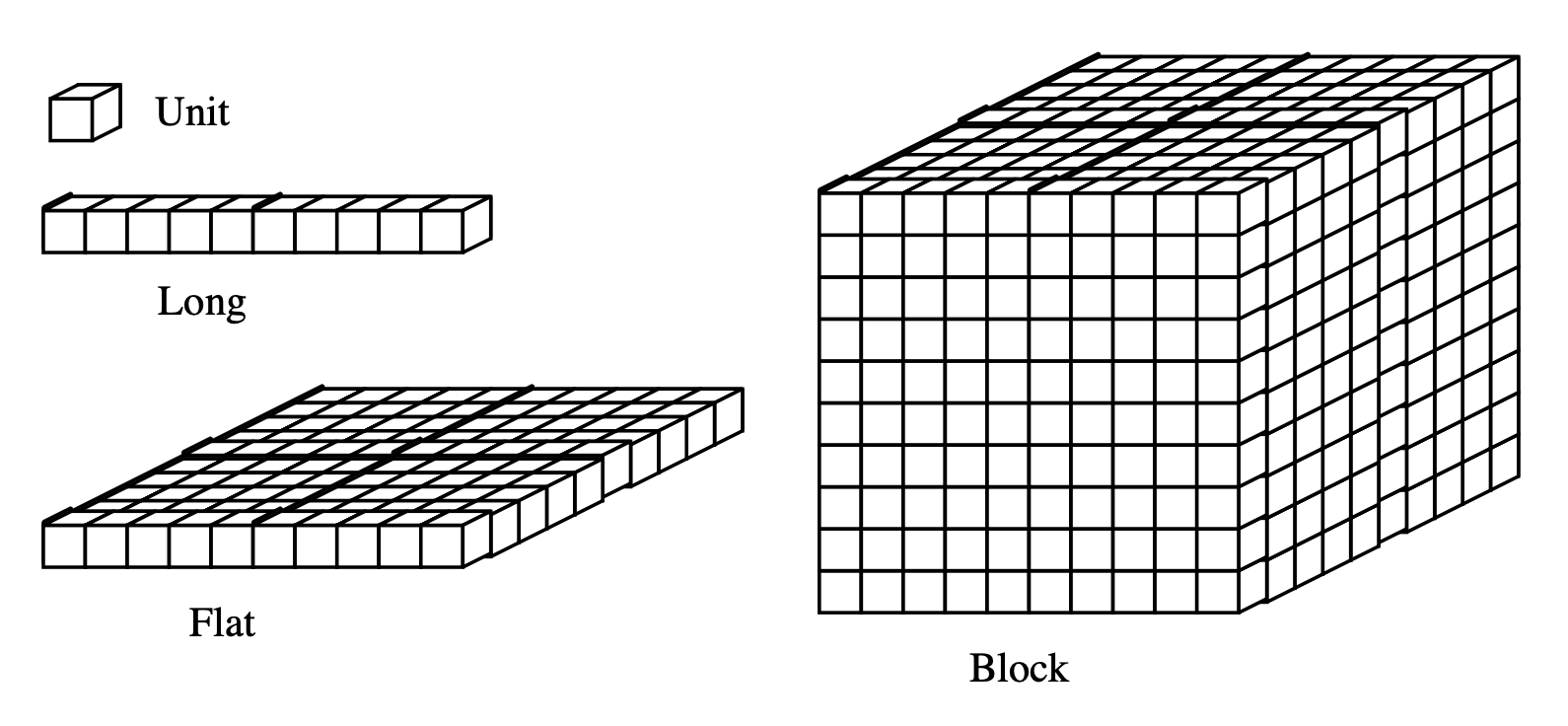
Consider the following set of blocks (often referred to as Dienes Blocks after the Math Educator, Zoltan Dienes). If you do not have physical blocks, you can use the interactive applet in Figure 2.1.15.
Figure2.1.14.Base Ten Blocks (aka Dienes Blocks)
Figure2.1.15.Virtual Base Ten Blocks
(a)
If a unit represents 1, what does a flat represent? What does a long represent? What does a block represent?
(b)
If a long represents 1, what does a flat represent? What does a block represent?
(c)
Let a unit represent 1. Using combinations of blocks, flats, longs, and units, how would you represent:
Let a unit represent 1. Take 12 units. If you consider each unit, long, flat, and block as one object, how could you represent the same number with the fewest number of objects? (e.g. one long, two flats, and one unit make up 4 objects).
(e)
Let a unit represent 1. Take 13 units, and 14 longs. If you consider each unit, long, flat, and block as one object, how could you represent the same number with the fewest number of objects?
(f)
Represent 274 with Dienes blocks. You need ____________ blocks, ____________ flats, ___________ longs, and _____________ units.
Represent 1741 with Dienes blocks. You need ____________ blocks, _____________ flats, ___________ longs, and _____________ units.
Place these sets of objects together. This represents the sum \(274+1741\text{.}\) Before regrouping, you now have___________ blocks, ____________ flats, ___________ longs, and _____________ units.
Does this immediately give the base-10 representation of the sum? Explain.
Make appropriate trades to get the base-ten representation of the sum. What is \(274+1741\text{?}\)
Did you have to know any "addition facts" to solve this problem with Dienes blocks? Explain.
Again, one of the reasons we do not want children to simply recognize a collection of symbols as representing a single number is that it masks the meaning behind how our numeration system is expressed. We must first expect children from an early age to form bundles of varying sizes and count how many of each there are before then translating this into symbols used to represent the number. Jerome Bruner, the noted learning theorist, suggested that children must go through three main phases in order to understand representations: Enactive, Iconic, and finally Symbolic (Bruner, 1964). In the enactive stage, the students "do" something to act out a process or concept. The iconic stage consists of students producing images that are raw representations of the process or concept. These representations usually lead to limitations requiring a refinement into more abstract symbolic representations. By experiencing these stages in order, meaning is attached to the symbols so that students can understand what they are symbolizing as opposed to just memorizing without meaning. Kaput, Blanton, and Moreno’s (2008) model is an extension of this theory and we will discuss their mechanisms for transition among these phases later when we look at algebraic concepts. For now, we can see an example of an elementary teacher engaging Kindergartners in Bruner’s theory in the video in Figure 2.1.16.
Figure2.1.16.Kindergartners Learning Base-Ten Place Value
Activity2.1.6.
Now that you have watched the video excerpt from the Kindergarten class, let’s analyze the classroom exchange in greater detail with respect to Bruner’s theory on concept development with respect to the stages of: Enactive, Iconic, and Symbolic.
(a)
In your groups, discuss the goal the teacher has as he introduces his "ten friend" at time stamp 2:23. How does he engage the students and what stage of Bruner’s model is the teacher using?
(b)
At time 2:32, one student blurts out, "It’s like a ten frame", referring to a grouping frame that the students have used to place single unit cubes into a bundle of ten when using their manipulatives. What aspect of Pirie and Kieren’s model is the student using?
(c)
At time 3:19, the same student who commented about the ten frames, states, "Oh, you added". When we think about the work we have done in Activity 2.1.4, where do you think the teacher might go with this comment when the class begins using symbols/digits to express expanded base-ten notation? How would you express 11 in expanded base-ten notation?
(d)
At time 4:15, the teacher asks Jalen to go up and make the total value 14, but then quickly changes his thought to 12. In your groups, discuss why you think the teacher made this sudden change.
(e)
As the students form different numbers using the "Ten Friends" and "One Friends", notice that the teacher holds his hand over the objects as the children respond. What do you think the teacher is trying to accomplish by this gesturing?
(f)
At 7:00 into the lesson, the teacher has students pick up 4 "Ten Friends" and 4 "One Friends" to then determine the number 44. Discuss in your groups why it might have been better for the teacher to have asked the students grabbing "One Friends" to grab an amount other than 4.
(g)
At 8:28, a student shares, "I get it now." and the teacher then presses for an explanation. In explaining, the student states, "Always the biggest number goes first and the little ones goes last". The teacher then re-voices the student’s comment to clarify what he meant by "biggest" meaning not the number of an object (since both were 4), but rather the size of grouping. Based on this student’s comment, do you think the students have experience writing numerals on paper? Explain your reasoning.
(h)
The teacher has the students form 35 using the manipulatives and at 9:35 he points as the students count, first by tens. However, before continuing the counting of the ones, the teacher pauses. Why do you think the teacher chose to pause?
(i)
At the end of the lesson, the teacher has the children get scissors, glue, pencils, and a clipboard. To what stage in Bruner’s model is the teacher transitioning? In your groups, discuss what you think the teacher will have the students do next along with the purpose of each of the tools: scissors, glue, pencils, and clipboard in the activity. How is this related to Bruner’s stages of development?
You may have noticed the children in the previous video excerpt "folding back" on their prior expereinces as they began to make connections between the "Ten Friends" and "One Friends" in physical sense and the numerals they have already experienced in their daily lives. So what does this mean for the students in Abby’s class from the earlier vignette Activity 2.1.1 at the beginning of this section? To wrap up this subsection, consider the following revisit to Abby’s class.
Activity2.1.7.Abby’s Lesson on Scientific Notation-Revisited.
Recall that in Abby’s class, Mia becomes frustrated because her question about why the process Abby is teaching works. Mia is desparately trying to make sense of the algorithm, but is not able to connect it to her previous experiences in a satisifying way. Now that we can express numbers in expanded base-ten notation, let’s think about how the mathematics might help Abby address Mia’s concern.
(a)
Let’s look at the same number from the vignette, \(372,400\) or \(3.724 \times 10^5\text{.}\) In your groups, use your whiteboards to write the number \(3.724\) as a sum of four whole numbers or fractions where each digit is represented by one of the four terms in your sum.
(b)
Using your sum from part (a), use the distributive property and multiply your sum by \(10^5\text{,}\) expressing your result still as a sum of four terms. Explain how your new representation is connected to the expanded base-ten notation that you used in Activity 2.1.4. How might Abby have used this idea to help Mia grasp the connection between what she already knew (folding back to place value) and the algorithm Abby was teaching?
(c)
Abby wants students to be able to move back and forth between scientific notation and standard notation for numerals. What questions might Abby ask to reverse your distributive property from part (b) to go from a numeral in standard base ten notation to scientific notation? If the number in scientific notation is expected to be given in a certain number of significant digits, how would Abby deal with the undesired digits once they have expressed the number as a sum with fractions? Discuss how "significance" might be an appropriate word here when thinking about the fractions and Toby’s comment from the vignette. How is a fractional representation helpful when it comes to a digit’s insignificance?
Subsection2.1.2Extension of the Number System to Integers
As time went on, the need arose to represent the concept of debt. Since cultures had created the whole numbers and a way to represent them, they again chose to extend the current number system to accommodate the need to represent quantities that were the "opposite" of the positive integers. Thus, the accepted set of numbers became the integers, denoted \(\mathbb{Z}=\left\{\ldots,-3,-2,-1,0,1,2,3,\ldots\right\}\text{.}\)
However, operations on these negative numbers were still looked at with skepticism. For example, what does it mean to multiply two negative numbers? Adding a negative to a positive had some meaning since the debt model would mean that some of the positive value would be cancelled by the negative values. Multiplying a negative by a positive value also had some meaning since if we owe three people $10, then it makes sense that \(3 \cdot -10=-30\text{.}\) But what about multiplying two negative numbers? Consider the video in Figure 2.1.17.
Figure2.1.17.Using a Pile-and-Hole Model for Integer Multiplication
Activity2.1.8.
In the video in Figure 2.1.17, we looked at a pile-and-hole model where piles of sand represented positive values and holes represented negative values. When a pile comes in contact with a hole, we get level ground (i.e. zero). In this activity, we will explore this idea using two different colored chips (one color for positive and one color for negative). Using these chips, with blue as positive and red as negative, respond to the following questions.
(a)
With the chips, form the numbers \(12\) and \(-7\text{.}\) If you place a blue chip on top of a red chip, this is equivalent to placing a pile into a hole. Combine a blue chip with a red chip for as many chips as you can. If the red and blue combinations represent a filled hole (aka zero), what is the numerical result of the remaining chips? What addition problem does this represent?
(b)
With the chips, form the numbers \(-10\) and \(6\text{.}\) Again, combine a blue chip with a red chip for as many chip that you can. If the red and blue combinations represent a filled hole (aka zero), what is the numerical result of the remaining chips? What addition problem does this represent?
(c)
When we begin to examine multiplication, let’s begin with "level" ground (i.e. zero). With the sand example, if we wanted to represent \(3 \cdot -2\text{,}\) we began with flot sand and "created" three sets of two holes (the first number represents creating or placing and the second number represents the object that we are creating or placing). The result was that we had six holes meaning that the result was \(-6\text{.}\) For this question, with your chips, act out the multiplication \(5 \cdot -3\text{.}\) Explain the meaning of your result.
(d)
With your chips, act out the multiplication \(-2 \cdot 4\text{.}\) Remember that the first number represents the act of creating or placing objects and so a negative value would need to represent the act of removing objects. Also, you need to begin with zero. Explain the meaning of your result.
Hint.
To begin with zero and still have piles to "remove", what must you also have so that you begin with a "flat" surface (i.e. zero)?
(e)
With your chips, act out the multiplication \(-3 \cdot -5\text{.}\) Remember that the first number represents the act of creating or placing objects and so a negative value would need to represent the act of removing objects. Also, you need to begin with zero. Explain the meaning of your result.
Hint.
To begin with zero and still have holes to "remove", what must you also have so that you begin with a "flat" surface (i.e. zero)?
As convincing as our pile-and-hole model may seem from a physical manipulative perspective, it should not seem too surprising that negative numbers had not been widely accepted for many years since reasoning by analogy can give us insight, but it hardly constitutes abstract proof. Mathematicians were still very skeptical of negative numbers even in the 1700s (this is around the time of the founding of the USA). This is really not that long ago. In fact, in 1770 Euler used basic properties of the number system to show the product of two negatives is positive. His proof is really not that involved and can be followed by most middle school students familiar with the properties of additive and multiplicative identities, additive inverses (i.e. "opposites"), the distributive property of multiplication over addition, and the zero product property (see Theorem 2.1.18).
Theorem2.1.18.Euler’s Proof that the Product of Two Negatives Is Positive.
The product \(-1 \cdot -1=1\text{.}\)
Proof.
Consider that \(\left(-1\right) \cdot \left(-1\right)=\left(-1\right) \cdot \left(-1\right)+0\text{,}\) since \(0\) is the additive identity. This now leads to the fact that \(\left(-1\right) \cdot \left(-1\right)+0=\left(-1\right) \cdot \left(-1\right)+\left(-1\right)+1\) since \(-1\) and \(1\) are additive inverses. But, \(\left(-1\right) \cdot \left(-1\right)+\left(-1\right)+1=
\left(-1\right) \cdot \left(-1\right)+\left(-1\right) \cdot \left(1\right)+1\) as \(1\) is the multiplicative identity. The distributive property now allows us to factor out \(-1\) from the first two terms of this expression giving \(\left(-1\right) \cdot \left[-1+1\right]+1\text{.}\) Since \(-1+1=0\text{,}\) this leads to \(\left(-1\right) \cdot \left[-1+1\right]+1=\left(-1\right) \cdot 0+1\text{.}\) Finally, since the product of any number and \(0\) is \(0\text{,}\) this shows that \(\left(-1\right) \cdot 0+1=0+1\) and as \(0\) is the additive idenity, we get \(0+1=1\text{.}\) Since this line of reasoning began with \(\left(-1\right) \cdot \left(-1\right)\text{,}\) we have shown that \(\left(-1\right) \cdot \left(-1\right)=1\text{.}\)
Subsection2.1.3Rational and Irrational Numbers
Eventually, there was a need to represent quantities that were smaller than a whole unit (for a fun cartoon see Figure 2.1.19 below) and so the rational numbers again extended the known set of numbers. To the Greeks, all quantities could be expressed as the quotient of two integers and so the rational numbers, denoted \(\mathbb{Q}=\left\{\frac{a}{b} \mid a,b\in \mathbb{Z} \right\}\text{,}\) came to be the accepted system of numbers.
Figure2.1.19.The Weird Number
Activity2.1.9.
Take a square piece of paper and fold it along one edge into thirds (fold it like a formal letter that you are putting into an envelope). Now unfold the square and using the side adjacent to the side you just used to fold it into thirds, fold it in half and then fold it into half again (essentially folding into fourths).
(a)
Highlight along the "thirds" edge, two of the three segments along that direction (this represents 2/3 of the unit length).
(b)
In a similar manner, highlight along the "fourths" edge, three of the four segments along that direction (this represents 3/4 of the unit length).
(c)
Shade the entire rectangle formed by the two edges that you have just shaded. What does this area represent?
(d)
How many small rectanlges have you shaded? Where does this number come from with respect to the two fractions that they represent (2/3 and 3/4)?
(e)
How many total small rectanlges are there in your original square? Where does this number come from with respect to the two fractions that they represent (2/3 and 3/4)?
(f)
If you were to express the fraction of small shaded rectangles as compared to the total number of small rectangles in the square, how would you state it?
There are ____________________ out of ____________________ small rectangles that are shaded.
(g)
Explain how you would express the statement from part (f) as a fraction.
(h)
Based on your observations, give a process that could be used for multiplying fractions.
Activity2.1.10.
Think back to when you learned to add whole numbers during elementary school.
(a)
In your groups, discuss how you recall "adding" sets of objects in, say, Kindergarten. What did you do with the objects?
(b)
As you think about your response to part (a), how would you describe the objects you "added"? Were they treated the same in terms of the counting or differently?
(c)
With respect to Pirie and Kieren’s model, what would be some primitive knowing concepts that might be used to begin thinking about "adding" rational numbers?
(d)
In thinking about the video, The Weird Number, would all slices of cake be treated equally when "counting" them or are some slices treated differently when trying to "add"? Consider the number of slices in the portion of cake stolen by that scoundrel \(\frac{2}{3}\) versus the number of slices stolen by \(\frac{4}{6}\text{.}\)
(e)
In your groups, discuss why non-integer rational numbers need to have the same denominator in order to add them.
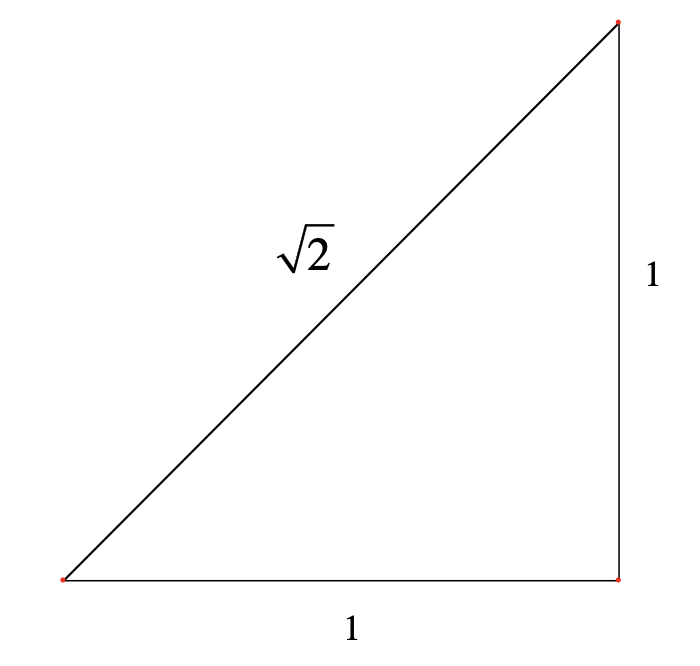
When Pythagoras’ work suggested that the hypotenuse of a right isosceles triangle with legs of length 1 could not be represented as the quotient of two integers (see Figure 2.1.20) and therefore, his work was considered heresy. According to Pythagoras, if \(a\) and \(b\) are the lengths of the legs of a right triangle, then their relationship to the length, \(c\text{,}\) of the hypotenuse was, \(a^2+b^2=c^2\text{.}\) So if \(a=b=1\text{,}\) then this would say that \(c^2=1^2+1^2=1+1=2 \Rightarrow c=\sqrt{2}\text{.}\) However, \(\sqrt{2}\) would then need to be a rational number if all numbers must be rational (according to the Greeks at the time). The problem is that if we make this assumption, we get a contradiction (see Theorem 2.1.21).
Figure2.1.20.Isoceles Right Triangle with Legs of Length 1
Theorem2.1.21.Irrationality of \(\sqrt{2}\).
The \(\sqrt{2}\) is not rational.
Proof.
(By contradiction) Suppose \(\sqrt{2}\) is rational. Then there exist \(a,b \in \mathbb{Z}\) such that \(\sqrt{2}=\frac{a}{b}\) where \(a\) and \(b\) have no common divisors except 1 (i.e. \(\frac{a}{b}\) is in lowest terms). Then \(2=\frac{a^2}{b^2}\) and thus \(a^2=2b^2\text{.}\) Since \(2 \vert a^2\text{,}\) this implies \(a^2\) is even. If \(a^2\) is even, then \(a\) must also be even because if \(a\) were odd then \(a^2\) would be odd as well.
Therefore, let \(a=2k\) for some \(k \in \mathbb{Z}\text{.}\) By substitution, \(\left(2k\right)^2=2b^2\) and so \(4k^2=2b^2\text{.}\) Dividing by 2 we get \(2k^2=b^2\) and thus \(b^2\) is even (has 2 as a factor) and therefore \(b\) is also even. But \(a\) and \(b\) were assumed to have no common divisors except 1. Since \(2 \vert a\) and \(2 \vert b\) we have a contradiction and so \(\sqrt{2}\) must be irrational.
Note that this proof can be replicated for \(\sqrt{p}\) for any prime, \(p\text{.}\)
Eventually, these irrational numbers such as \(\sqrt{2}\) became accepted by the mathematical community and thus the current number system of the time was again extended to include both rational and irrational numbers. This set of numbers formed by the union both of these sets is called the real numbers, denoted \(\mathbb{R}\text{.}\) Other well-known irrational numbers include transcendentals such as \(\pi\) and \(e\text{.}\)
Exercises2.1.4Exercises
1.
Express the following Hindu-Arabic numerals as Egyptian numerals or Egyptian numerals as Hindu-Arabic numerals.
(a)
13,745
(b)
304,341
(c)
4,671
(d)
Egyptian numeral
2.
Express the following Hindu-Arabic numerals as Babylonian numerals or Babylonian numerals as Hindu-Arabic numerals.
(a)
123,155
(b)
1,632
(c)
75,652
(d)
Babylonian numeral
3.
Express the following Hindu-Arabic numerals as Mayan numerals or Mayan numerals as Hindu-Arabic numerals.
(a)
5,493
(b)
3,972
(c)
Mayan numeral
4.
Convert the following base-ten numerals to the desired base.
(a)
3247 to base seven.
(b)
95,314 to base five.
(c)
3527 to base three.
(d)
\(321_{four}\) to base five.
5.
Express the numeral \(134_{five}\) as a base-four numeral by sketching bundling sticks and rebundling. Then show the equivalence by expressing the quantity in expanded base notation (using Hindu-Arabic numerals) for both base five and base four.
6.
Express the numeral \(134_{five}\) as a base-four numeral by sketching base blocks and rearranging them from base-five blocks to base-four blocks. Then show the equivalence by expressing the quantity in expanded base notation (using base ten numerals) for both base five and base four.
7.
Using chips of two different colors (or a pile-hole model) explain how you would perform the following computations with manipulatives by drawing sketches and writing your explanations. Be mindful what values or actions are being represented by the first or second number in each case and be consistent throughout your responses.
(a)
\(-5+3\)
(b)
\(-7+^{-}2\)
(c)
\(4\cdot ^{-}3\)
(d)
\(-6 \cdot 2\)
(e)
\(-3 \cdot ^{-}4\)
8.
Sketch an area model for multiplying \(\frac{3}{5} \cdot \frac{2}{7}\) explaining where the numerator and denominator come from with respect to your sketch.